
No products in the cart.
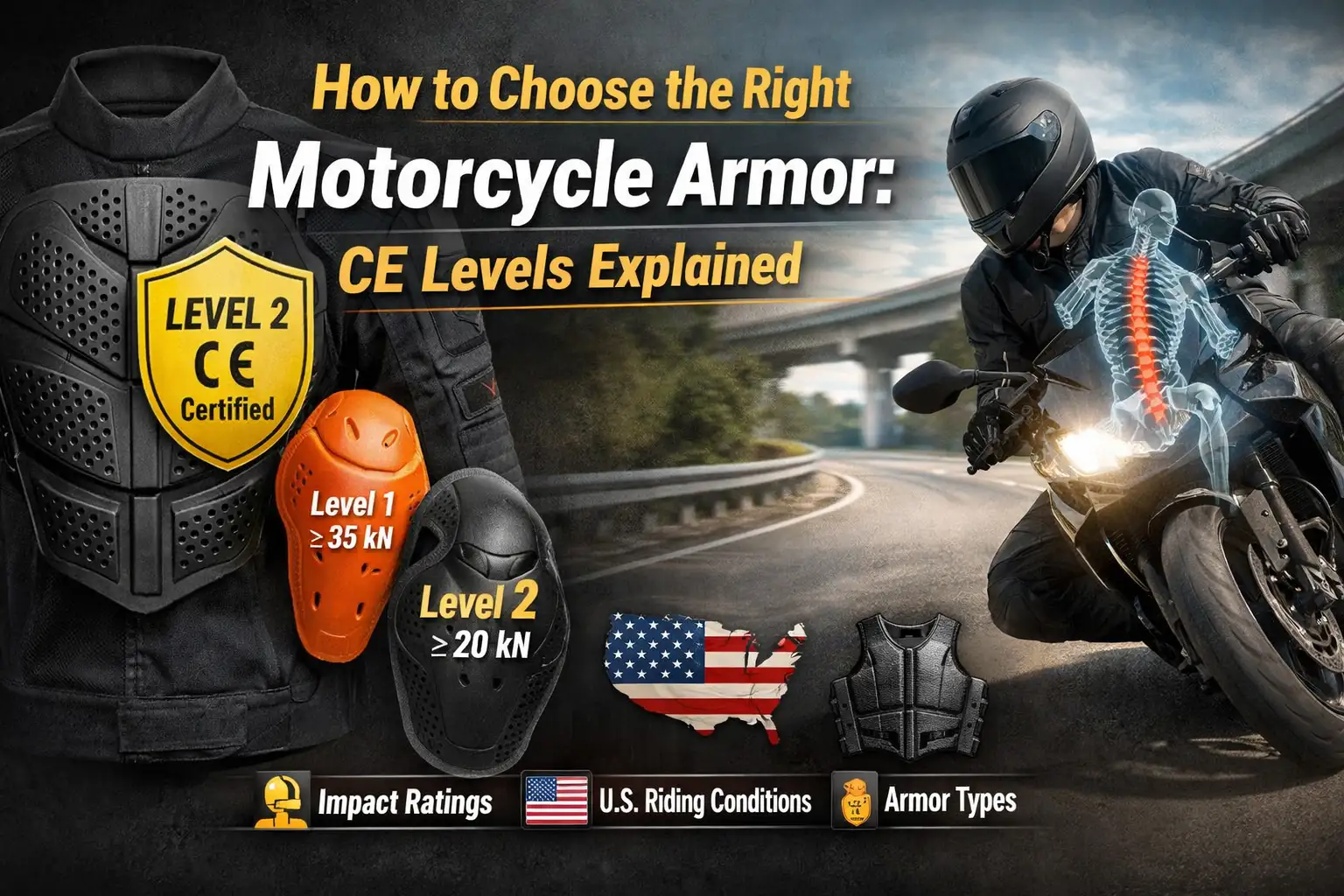
How to Choose the Right Motorcycle Armor: CE Levels Explained
Motorcycle armor is not just an add-on to your riding gear. It plays a direct role in reducing injury severity during real-world crashes. Many riders in the United States still choose gear based on appearance or brand reputation without understanding how CE protection levels actually work. Knowing how armor is tested and rated allows you to make decisions based on safety performance rather than marketing claims.
This guide explains CE levels in detail and helps you choose the right motorcycle armor based on riding style, speed, climate, and risk exposure, using insights that experienced riders and industry professionals rely on.
What CE Rated Motorcycle Armor Means
CE refers to Conformité Européenne, a global certification system used to test safety equipment. For motorcycle armor, CE testing measures how much impact energy passes through the armor and reaches the rider’s body. The lower the transmitted force, the better the protection.
Although CE certification is not legally required in the United States, it has become the most trusted standard worldwide. Most high-quality motorcycle armor sold in the U.S. follows CE testing benchmarks.
CE Standards Used for Motorcycle Armor
There are two primary CE standards that apply to protective motorcycle armor.
CE EN 1621-1 for Limb and Joint Protection
This standard applies to armor used in shoulders, elbows, hips, and knees. During testing, a fixed amount of force is applied to the armor, and sensors measure the energy transferred through it.
Level 1 armor allows up to 35 kilonewtons of force to pass through. Level 2 armor allows no more than 20 kilonewtons. Level 2 therefore provides significantly higher impact absorption and injury reduction.
CE EN 1621-2 for Back Protectors
Back protectors are tested under a stricter standard due to the high risk of spinal injury. Level 1 back armor allows up to 18 kilonewtons of transmitted force, while Level 2 back armor limits it to 9 kilonewtons.
Many motorcycle jackets sold in the U.S. include only a basic foam insert rather than certified back protection. Riders should always verify whether their back armor is truly CE certified.
Choosing Between CE Level 1 and CE Level 2 Armor
CE Level 1 armor is suitable for riders who primarily commute at lower speeds, ride shorter distances, or prioritize lightweight comfort in hot climates. It offers basic protection but should be viewed as a minimum standard.
CE Level 2 armor is recommended for riders who spend time on highways, ride long distances, tour regularly, or ride at higher speeds. It absorbs substantially more impact energy and offers better protection in serious crashes.
Many experienced riders use a mixed approach, choosing Level 2 armor for the back, shoulders, and elbows while using Level 1 armor for hips and knees to maintain comfort without sacrificing core protection.
Why Armor Coverage and Fit Matter
Protection level alone does not determine effectiveness. Armor must cover the correct impact zones and remain in place while riding. Poorly positioned armor will not protect you during a crash, regardless of its CE rating.
The most critical areas to protect include shoulders, elbows, back, hips, and knees. Armor should sit correctly when you are in a riding position, not just when standing. If it shifts easily while seated, it is unlikely to protect you properly during impact.
Types of Motorcycle Armor and Their Performance
Viscoelastic armor is widely used in modern protective gear. It remains soft and flexible during normal movement but hardens instantly on impact. This type of armor provides an excellent balance of comfort and protection and is commonly used in CE Level 2 applications.
Hard shell armor uses a rigid outer layer to distribute impact forces across a wider surface. It is often paired with internal padding and is more commonly found in off-road and adventure riding gear.
Basic foam pads that are not CE certified offer minimal protection and are often included in entry-level jackets only to fill armor pockets. These should be replaced with certified armor whenever possible.
Riding Conditions and U.S. Specific Considerations
American riders often face long highway stretches, high-speed traffic, and changing weather conditions. Armor choices should reflect these realities.
For hot climates, ventilated or perforated CE Level 2 armor provides protection without excessive heat buildup. For colder conditions or touring, slightly thicker armor can be worn comfortably for extended periods.
Urban riders may find CE Level 1 acceptable for short commutes, but highway riders and touring riders should strongly consider CE Level 2 protection.
How to Verify CE Certification
Certified armor will clearly display a CE mark along with the standard number and level rating. For example, EN 1621-1 Level 2 or EN 1621-2 Level 2. If this information is missing, the armor should not be assumed to be certified.
Reputable sellers such as Riders Armor clearly list protection standards and ratings, which allows riders to make informed safety decisions when purchasing gear online.
Common Mistakes Riders Make When Choosing Armor
Many riders assume their jacket includes certified protection when it does not. Others choose lower protection levels for high-speed riding or ignore back protection entirely. Style and fit are often prioritized over actual safety performance, and factory-installed foam pads are rarely upgraded.
Avoiding these mistakes can significantly reduce injury risk in the event of a crash.
Final Thoughts
Motorcycle armor should be chosen based on crash protection, not just comfort during the ride. CE ratings provide measurable, tested data that helps riders understand how gear performs under impact.
By understanding CE levels, coverage areas, and riding conditions, you can select armor that matches your real-world risk. Reliable sources like RidersArmor make this process easier by offering transparency about protection standards.
FAQs
What is CE rated motorcycle armor?
CE rated motorcycle armor is protective gear tested under European safety standards to measure how much impact force is transferred to the rider during a crash. Lower force transmission means better protection.
Is CE Level 2 armor better than Level 1?
Yes. CE Level 2 armor absorbs significantly more impact energy than Level 1, making it a better choice for highway riding, touring, and higher-speed conditions common in the United States.
Do motorcycle jackets come with real CE armor?
Many jackets include only basic foam inserts, not certified armor. Riders should always check for CE markings such as EN 1621-1 or EN 1621-2 and upgrade if necessary.
Is back armor really necessary?
Back armor is one of the most important protective components because spinal injuries can be severe. CE Level 2 back protectors offer the highest level of impact absorption and are strongly recommended.
Does thicker armor always mean better protection?
Not always. Modern viscoelastic armor can be thin, flexible, and still provide excellent impact absorption. Protection depends on CE certification, not just thickness.